CrackerJacks
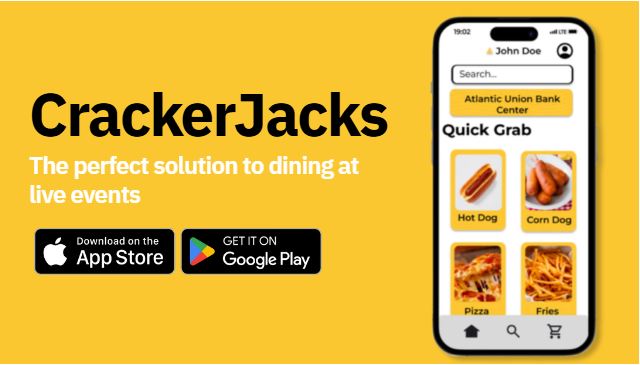
CrackerJacks is a seamless mobile app that lets users order food and drinks at live events without leaving their seats. Designed for stadiums, arenas, and theaters, the app allows guests to browse menus, place orders, and get their food delivered straight to them.
ROLE
CLIENT
PROJECT TYPE
TOOLS
Designed and developed the user experience and interface for CrackerJacks, focusing on intuitive navigation, accessibility, and visual consistency. Conducted user research, created wireframes and prototypes, and collaborated with developers to ensure seamless implementation.
UI/UX Designer
Lansdowne Technology Consulting
Sketch, Figma
CrackerJacks
CrackerJacks is a seamless mobile app that lets users order food and drinks at live events without leaving their seats. Designed for stadiums, arenas, and theaters, the app allows guests to browse menus, place orders, and get their food delivered straight to them.
ROLE
CLIENT
PROJECT TYPE
TOOLS
Designed and developed the user experience and interface for CrackerJacks, focusing on intuitive navigation, accessibility, and visual consistency. Conducted user research, created wireframes and prototypes, and collaborated with developers to ensure seamless implementation.
UI/UX Designer
Lansdowne Technology Consulting
Sketch, Figma
CrackerJacks
CrackerJacks is a seamless mobile app that lets users order food and drinks at live events without leaving their seats. Designed for stadiums, arenas, and theaters, the app allows guests to browse menus, place orders, and get their food delivered straight to them.
ROLE
CLIENT
PROJECT TYPE
TOOLS
Designed and developed the user experience and interface for CrackerJacks, focusing on intuitive navigation, accessibility, and visual consistency. Conducted user research, created wireframes and prototypes, and collaborated with developers to ensure seamless implementation.
UI/UX Designer
Lansdowne Technology Consulting
Sketch, Figma
CrackerJacks
CrackerJacks is a seamless mobile app that lets users order food and drinks at live events without leaving their seats. Designed for stadiums, arenas, and theaters, the app allows guests to browse menus, place orders, and get their food delivered straight to them.
ROLE
CLIENT
PROJECT TYPE
TOOLS
Designed and developed the user experience and interface for CrackerJacks, focusing on intuitive navigation, accessibility, and visual consistency. Conducted user research, created wireframes and prototypes, and collaborated with developers to ensure seamless implementation.
User Research, UX Designer, Prototyping
Figma, Adobe Photoshop
UX Design Problem
The Design Problem
The Design Problem
Ordering food at crowded events often means missing parts of the show due to long lines and confusing concession layouts. We set out to design an app that streamlines the ordering process, keeps the experience intuitive, and reduces friction for both guests and vendors.
The Design Problem
Ordering food at crowded events often means missing parts of the show due to long lines and confusing concession layouts. We set out to design an app that streamlines the ordering process, keeps the experience intuitive, and reduces friction for both guests and vendors.
Simple, scrollable menus organized by vendor or item type
Quick add-to-order buttons for speed
Live order tracking so users know when food is ready
Clean, modern UI to keep focus on the event, not the app
Key Freatures
Simple, scrollable menus organized by vendor or item type
Quick add-to-order buttons for speed
Live order tracking so users know when food is ready
Clean, modern UI to keep focus on the event, not the app
Key Freatures
Design Process
We started by defining our target users and mapping out their experience to uncover pain points and opportunities:
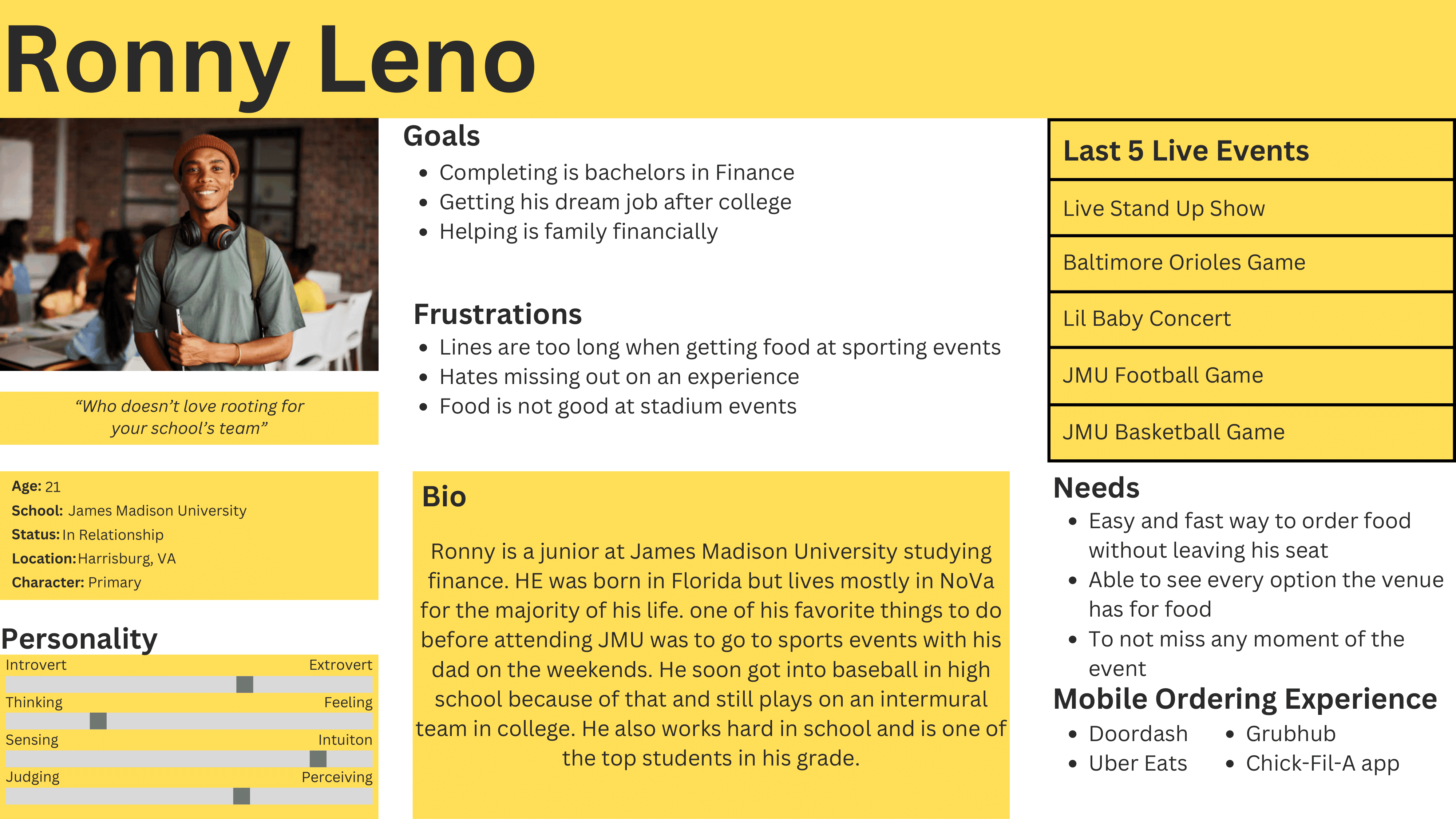
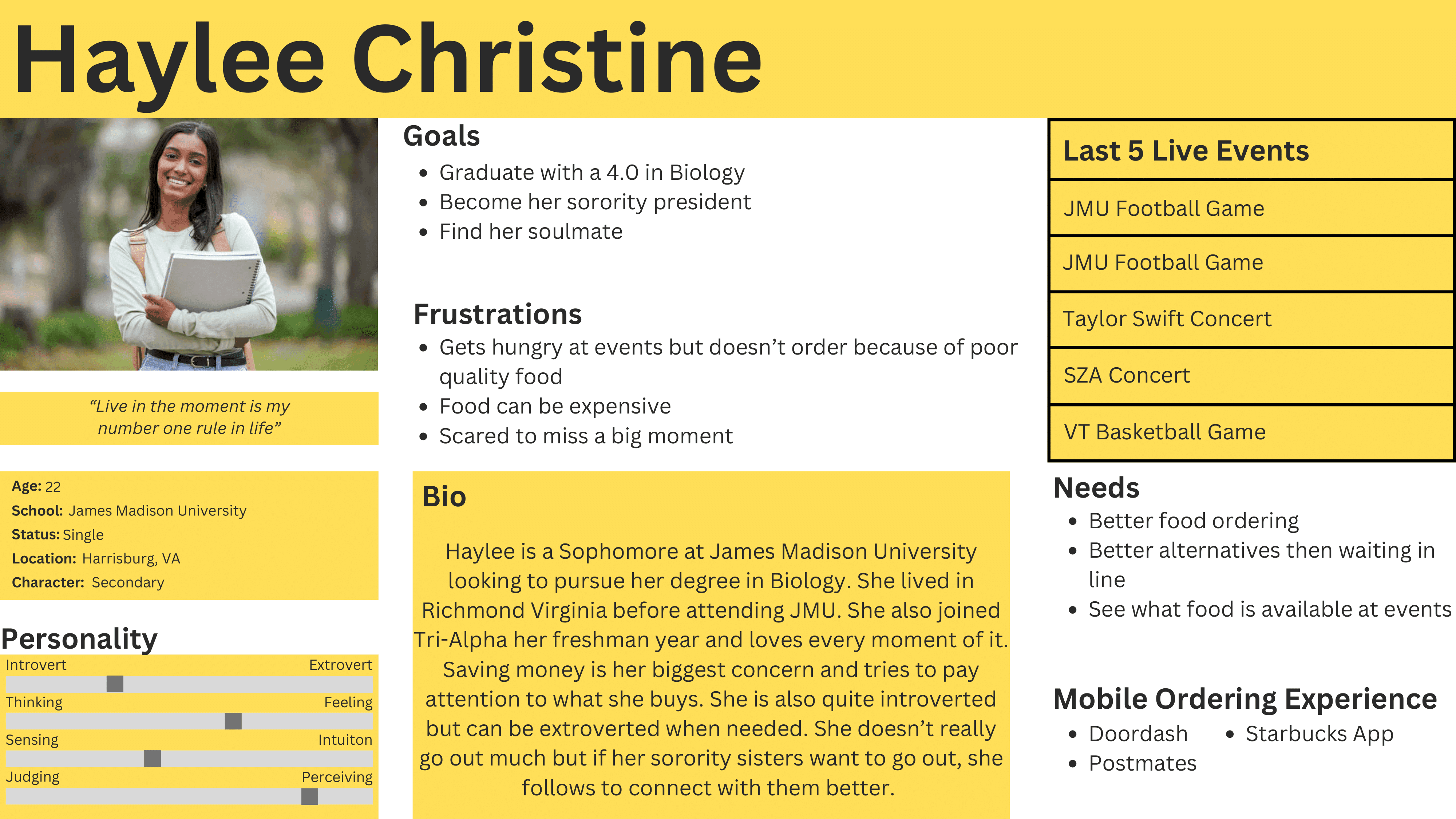
Personas: Created to represent typical concert-goers who value speed, simplicity, and staying engaged with the show.
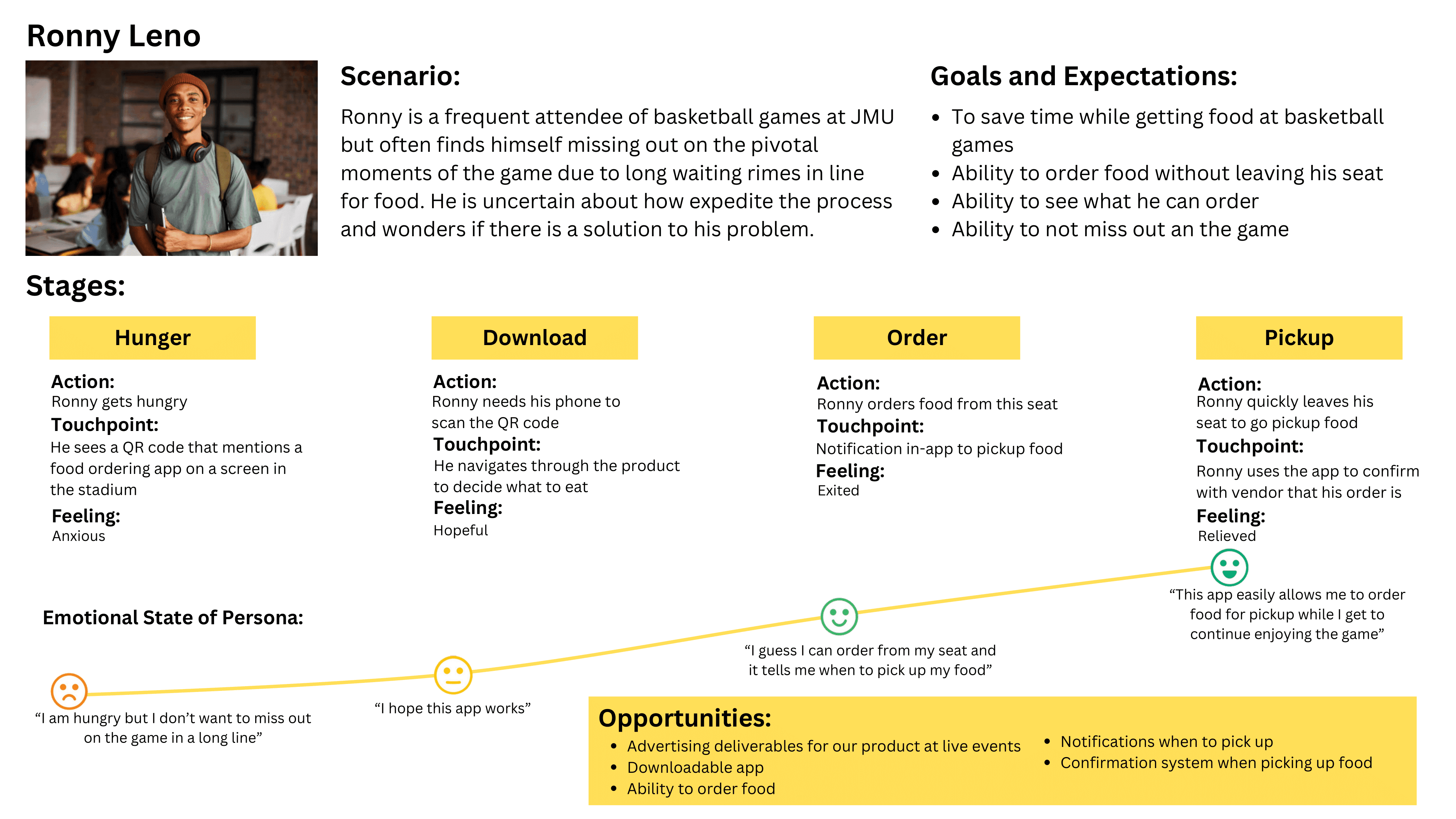
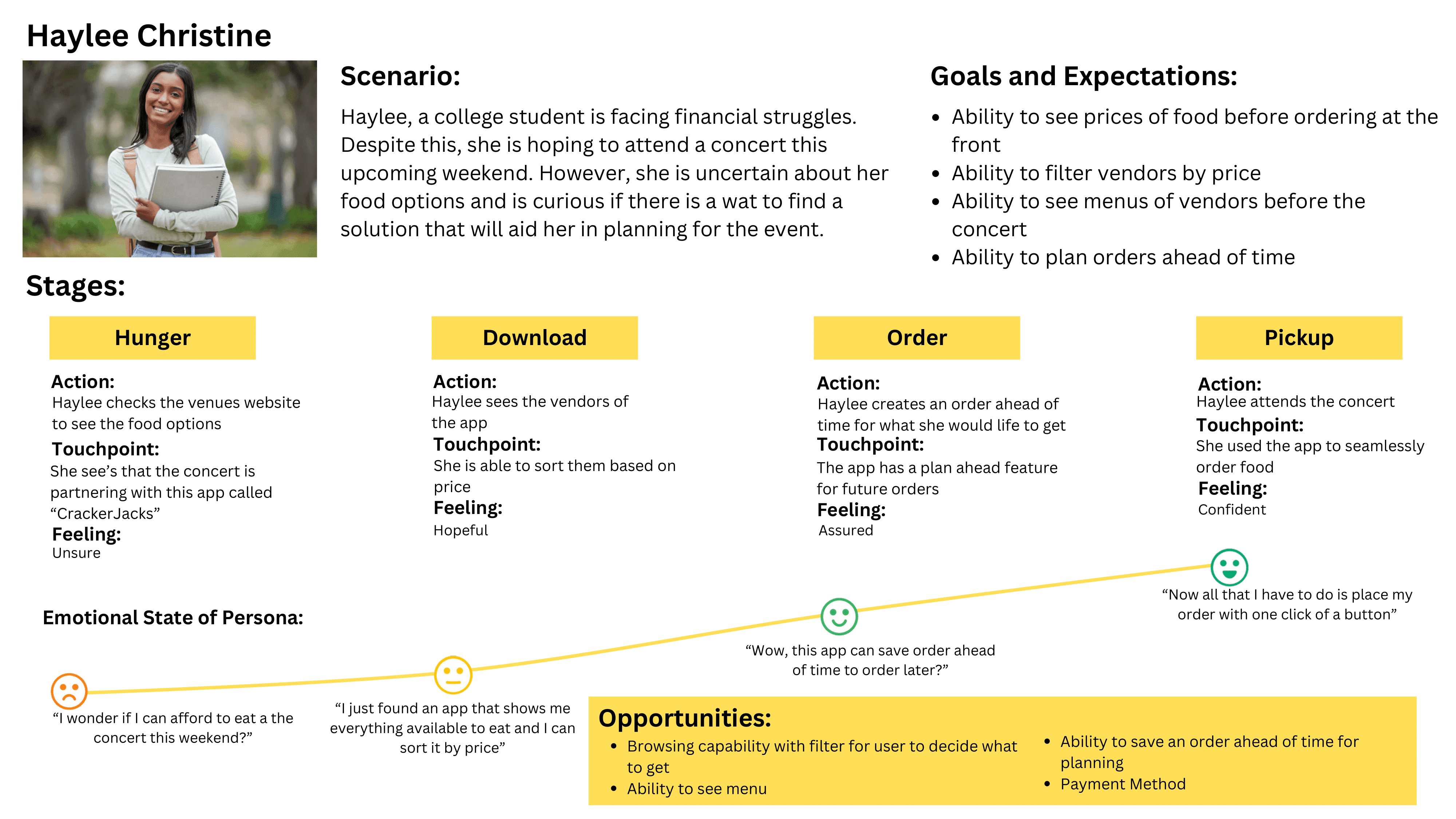
Journey Map: Helped us visualize the steps users take from realizing they’re hungry to successfully picking up their food — highlighting frustration points like long wait times and missing parts of the performance.
By understanding users’ motivations and frustrations, we kept our design focused on quick navigation, minimal steps to order, and real-time updates so guests can enjoy the event without interruption.
We started by defining our target users and mapping out their experience to uncover pain points and opportunities:
Personas: Created to represent typical concert-goers who value speed, simplicity, and staying engaged with the show.
Journey Map: Helped us visualize the steps users take from realizing they’re hungry to successfully picking up their food — highlighting frustration points like long wait times and missing parts of the performance.
By understanding users’ motivations and frustrations, we kept our design focused on quick navigation, minimal steps to order, and real-time updates so guests can enjoy the event without interruption.
Design Process
We started by defining our target users and mapping out their experience to uncover pain points and opportunities:
Personas: Created to represent typical concert-goers who value speed, simplicity, and staying engaged with the show.
Journey Map: Helped us visualize the steps users take from realizing they’re hungry to successfully picking up their food — highlighting frustration points like long wait times and missing parts of the performance.
By understanding users’ motivations and frustrations, we kept our design focused on quick navigation, minimal steps to order, and real-time updates so guests can enjoy the event without interruption.
We started by defining our target users and mapping out their experience to uncover pain points and opportunities:
Personas: Created to represent typical concert-goers who value speed, simplicity, and staying engaged with the show.
Journey Map: Helped us visualize the steps users take from realizing they’re hungry to successfully picking up their food — highlighting frustration points like long wait times and missing parts of the performance.
By understanding users’ motivations and frustrations, we kept our design focused on quick navigation, minimal steps to order, and real-time updates so guests can enjoy the event without interruption.
Design Process
We started by defining our target users and mapping out their experience to uncover pain points and opportunities:
Personas: Created to represent typical concert-goers who value speed, simplicity, and staying engaged with the show.
Journey Map: Helped us visualize the steps users take from realizing they’re hungry to successfully picking up their food — highlighting frustration points like long wait times and missing parts of the performance.
By understanding users’ motivations and frustrations, we kept our design focused on quick navigation, minimal steps to order, and real-time updates so guests can enjoy the event without interruption.
We started by defining our target users and mapping out their experience to uncover pain points and opportunities:
Personas: Created to represent typical concert-goers who value speed, simplicity, and staying engaged with the show.
Journey Map: Helped us visualize the steps users take from realizing they’re hungry to successfully picking up their food — highlighting frustration points like long wait times and missing parts of the performance.
By understanding users’ motivations and frustrations, we kept our design focused on quick navigation, minimal steps to order, and real-time updates so guests can enjoy the event without interruption.
User Personas
To define user personas, I conducted research through surveys, interviews, and data analysis to identify key user behaviors, goals, and pain points. Based on this data, I created detailed personas that represented different user types, including their motivations, frustrations, and needs. These personas guided design decisions, ensuring the product met real user expectations and provided a meaningful experience.
User Journey Maps
To define journey maps, I first gathered user research insights to understand pain points, motivations, and interactions with the product. Then, I mapped out key touchpoints, emotions, and actions across different stages of the user experience. This helped identify friction points and opportunities to enhance usability, ensuring a seamless and engaging user journey.
User Journey Maps
To define journey maps, I first gathered user research insights to understand pain points, motivations, and interactions with the product. Then, I mapped out key touchpoints, emotions, and actions across different stages of the user experience. This helped identify friction points and opportunities to enhance usability, ensuring a seamless and engaging user journey.
User Journey Maps
To define journey maps, I first gathered user research insights to understand pain points, motivations, and interactions with the product. Then, I mapped out key touchpoints, emotions, and actions across different stages of the user experience. This helped identify friction points and opportunities to enhance usability, ensuring a seamless and engaging user journey.
Outcome & Reflection
Crackerjacks makes ordering food at large venues faster and easier, helping guests stay engaged with the live event. Through this project, I learned how crucial it is to simplify user flows in time-sensitive contexts, and how collaborative iteration can improve both usability and visual design.
Nate Workneh ⏤ 2025